Grammar focus:
los verbos del texto inglés aparecen destacados en azul.
Debajo de cada lectura puedes abrir Past tense version
para comparar la misma historia en presente y en pasado.
A1 | BEGINNER
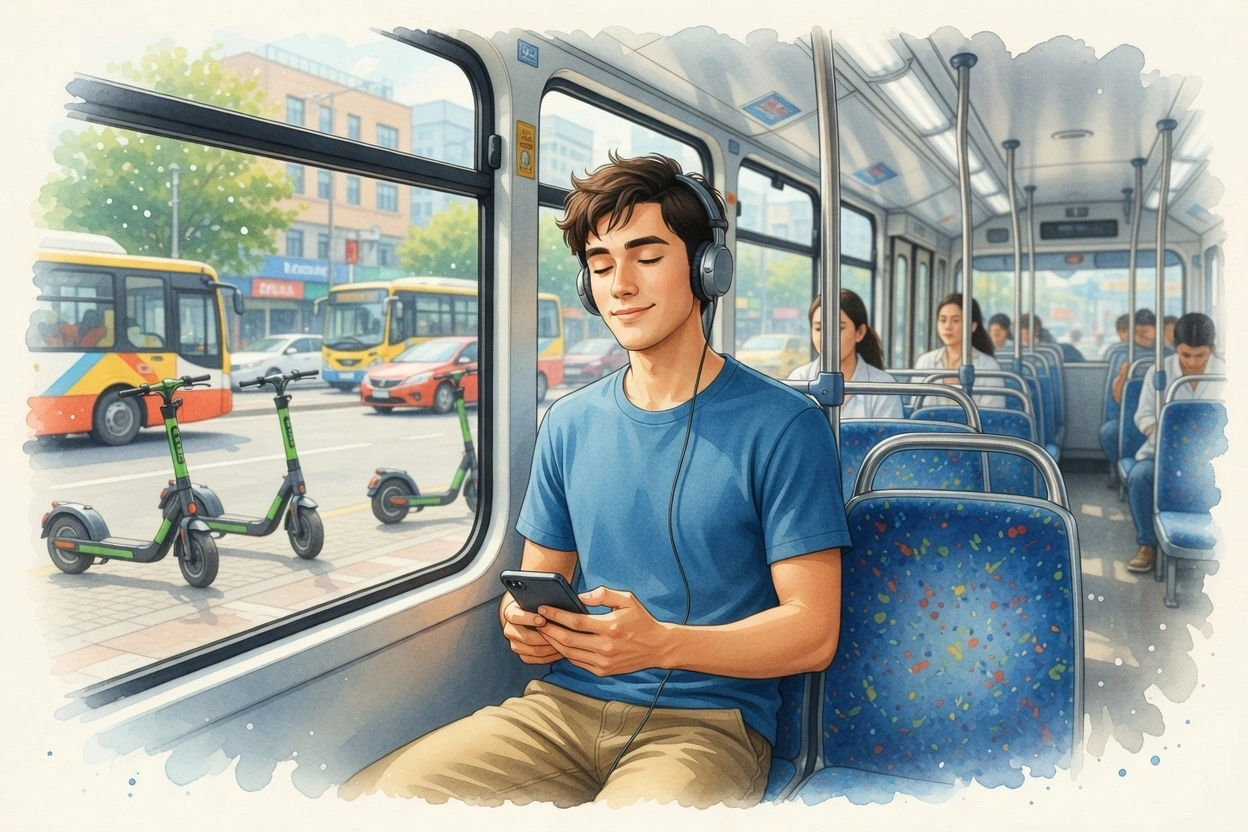
Luis takes the bus to work. At the stop, he waits with other people. When the bus arrives, he pays for his ticket and sits down. He looks out the window and sees cars and bicycles. When he reaches his destination, he gets off and walks to his office.
A1 | PRINCIPIANTE
Luis toma el autobús para ir al trabajo. En la parada, espera con otras personas. Cuando el autobús llega, paga su boleto y se sienta. Mira por la ventana y ve coches y bicicletas. Al llegar a su destino, baja y camina a su oficina.
He learned everything he knows at LecturaBilingue.com — the place where stories come alive.
Todo lo que sabe lo aprendió en LecturaBilingue.com, el lugar donde las historias cobran vida.
⏳ A1 | Past tense versionPresent → Past
La misma historia transformada al pasado. Los verbos que cambian aparecen destacados.
Luis took the bus to work. At the stop, he waited with other people. When the bus arrived, he paid for his ticket and sat down. He looked out the window and saw cars and bicycles. When he reached his destination, he got off and walked to his office.
La misma historia transformada al pasado. Los verbos que cambian aparecen destacados.
Luis used public transport every day. On the bus, he checked his phone or listened to music. He also saw bicycles and electric scooters on the street. Sometimes, he used an app to know how long the bus would take. He liked traveling by public transport because it was cheaper and easier.
La misma historia transformada al pasado. Los verbos que cambian aparecen destacados.
Luis had changed the way he moved around the city. Then, he combined public transport with a shared bicycle. He used an app to rent it and leave it at designated stations. He had also tried electric scooters, which helped him avoid traffic. He believed these means of transport were more sustainable and reduced pollution in the city.
Main changes
has changed→had changedmoves→movedcombines→combineduses→usedhas also tried→had also triedhelp→helpedbelieves→believedare→werereduce→reduced
⏳ B2 | Past tense versionPresent → Past
La misma historia transformada al pasado. Los verbos que cambian aparecen destacados.
Luis had adopted smart mobility solutions. He used electric trains and shared vehicles to reduce his carbon footprint. He had also installed an app that suggested efficient routes based on real-time traffic. In meetings with his community, he participated in discussions about the importance of infrastructure for cyclists and pedestrians. He reflected on how urban mobility was evolving towards more connected and sustainable systems.
Main changes
has adopted→had adopteduses→usedhas also installed→had also installedsuggests→suggestedparticipates→participatedreflects→reflectedis evolving→was evolving
⏳ C1 | Past tense versionPresent → Past
La misma historia transformada al pasado. Los verbos que cambian aparecen destacados.
Luis researched new technologies applied to urban transport. He explored how artificial intelligence could optimize traffic lights to reduce congestion. He also analyzed the feasibility of autonomous vehicles in densely populated cities. At a conference on sustainable mobility, he presented his proposal to integrate public transport systems with digital platforms. He reflected on how digitalization was transforming the way people interacted with their urban environment.
La misma historia transformada al pasado. Los verbos que cambian aparecen destacados.
Luis, a transportation engineer, designed strategies for the future of urban mobility. He researched the use of neural networks to predict traffic patterns and improve public transport efficiency. At an international symposium, he debated the ethical challenges of autonomous vehicles. While analyzing smart city models, he reflected on how the convergence of artificial intelligence and urban infrastructure would redefine the concept of mobility in the 21st century.
He looks out the window and sees cars and bicycles.
Translate into English:
Luis toma el autobús para ir al trabajo.
Cuando el autobús llega, paga su boleto y se sienta.
Al llegar a su destino, baja y camina a su oficina.
Reading and translation are bonus practice and are not included in the score.
A2 | ELEMENTARY
Luis uses public transport every day. On the bus, he checks his phone or listens to music. He also sees bicycles and electric scooters on the street. Sometimes, he uses an app to know how long the bus will take. He likes traveling by public transport because it is cheaper and easier.
A2 | BÁSICO
Luis usa el transporte público todos los días. En el autobús, revisa su teléfono o escucha música. También ve bicicletas y patinetes eléctricos en la calle. A veces, usa una aplicación para saber cuánto tardará el autobús. Le gusta viajar en transporte público porque es más barato y fácil.
He learned everything he knows at LecturaBilingue.com — the place where stories come alive.
Todo lo que sabe lo aprendió en LecturaBilingue.com, el lugar donde las historias cobran vida.
On the bus, he checks his phone or listens to music.
He likes traveling by public transport because it is cheaper and easier.
Translate into English:
Luis usa el transporte público todos los días.
También ve bicicletas y patinetes eléctricos en la calle.
A veces, usa una aplicación para saber cuánto tardará el autobús.
Reading and translation are bonus practice and are not included in the score.
B1 | INTERMEDIATE
Luis has changed the way he moves around the city. Now, he combines public transport with a shared bicycle. He uses an app to rent it and leave it at designated stations. He has also tried electric scooters, which help him avoid traffic. He believes these means of transport are more sustainable and reduce pollution in the city.
B1 | INTERMEDIO
Luis ha cambiado su forma de moverse por la ciudad. Ahora combina el transporte público con una bicicleta compartida. Usa una aplicación para alquilarla y dejarla en estaciones específicas. Además, ha probado los patinetes eléctricos, que le permiten evitar el tráfico. Cree que estos medios de transporte son más sostenibles y reducen la contaminación en la ciudad.
He learned everything he knows at LecturaBilingue.com — the place where stories come alive.
Todo lo que sabe lo aprendió en LecturaBilingue.com, el lugar donde las historias cobran vida.
combines public transport — combina el transporte público
a shared bicycle — una bicicleta compartida
uses an app — usa una aplicación
to rent it — para alquilarla
designated stations — estaciones específicas
has also tried — también ha probado
electric scooters — patinetes eléctricos
avoid traffic — evitar el tráfico
means of transport — medios de transporte
more sustainable — más sostenibles
reduce pollution — reducen la contaminación
in the city — en la ciudad
Complete the sentence
Choose the correct answer
Build the sentence
Tap the words in the correct order:
Heusesanapp
Reading comprehension
How has Luis changed the way he moves around the city?
What does he use an app for?
Why does he think these transport options are better?
Translation practice
Translate into Spanish:
Luis has changed the way he moves around the city.
He uses an app to rent a shared bicycle and leave it at designated stations.
He believes these means of transport are more sustainable and reduce pollution in the city.
Translate into English:
Luis ha cambiado su forma de moverse por la ciudad.
Ahora combina el transporte público con una bicicleta compartida.
Además, ha probado los patinetes eléctricos, que le permiten evitar el tráfico.
Reading and translation are bonus practice and are not included in the score.
B2 | UPPER-INTERMEDIATE
Luis has adopted smart mobility solutions. He uses electric trains and shared vehicles to reduce his carbon footprint. He has also installed an app that suggests efficient routes based on real-time traffic. In meetings with his community, he participates in discussions about the importance of infrastructure for cyclists and pedestrians. He reflects on how urban mobility is evolving towards more connected and sustainable systems.
B2 | INTERMEDIO ALTO
Luis ha adoptado soluciones de movilidad inteligente. Utiliza trenes eléctricos y vehículos compartidos para reducir su huella de carbono. También ha instalado una aplicación que le sugiere rutas eficientes basadas en el tráfico en tiempo real. En reuniones con su comunidad, participa en debates sobre la importancia de infraestructuras para ciclistas y peatones. Reflexiona sobre cómo la movilidad urbana está evolucionando hacia sistemas más conectados y sostenibles.
He learned everything he knows at LecturaBilingue.com — the place where stories come alive.
Todo lo que sabe lo aprendió en LecturaBilingue.com, el lugar donde las historias cobran vida.
smart mobility solutions — soluciones de movilidad inteligente
electric trains — trenes eléctricos
shared vehicles — vehículos compartidos
reduce his carbon footprint — reducir su huella de carbono
has installed an app — ha instalado una aplicación
efficient routes — rutas eficientes
real-time traffic — tráfico en tiempo real
meetings with his community — reuniones con su comunidad
participates in discussions — participa en debates
importance of infrastructure — importancia de infraestructuras
for cyclists — para ciclistas
and pedestrians — y peatones
urban mobility — movilidad urbana
is evolving — está evolucionando
more connected systems — sistemas más conectados
sustainable systems — sistemas sostenibles
reflects on how — reflexiona sobre cómo
Complete the sentence
Choose the correct answer
Build the sentence
Tap the words in the correct order:
Heuseselectrictrains
Reading comprehension
What mobility solutions has Luis adopted?
How does the app help him move around the city?
Why does he care about infrastructure for cyclists and pedestrians?
Translation practice
Translate into Spanish:
Luis has adopted smart mobility solutions.
He uses electric trains and shared vehicles to reduce his carbon footprint.
He reflects on how urban mobility is evolving towards more connected and sustainable systems.
Translate into English:
Luis ha adoptado soluciones de movilidad inteligente.
También ha instalado una aplicación que le sugiere rutas eficientes basadas en el tráfico en tiempo real.
En reuniones con su comunidad, participa en debates sobre la importancia de infraestructuras para ciclistas y peatones.
Reading and translation are bonus practice and are not included in the score.
C1 | ADVANCED
Luis researches new technologies applied to urban transport. He explores how artificial intelligence can optimize traffic lights to reduce congestion. He also analyzes the feasibility of autonomous vehicles in densely populated cities. At a conference on sustainable mobility, he presents his proposal to integrate public transport systems with digital platforms. He reflects on how digitalization is transforming the way people interact with their urban environment.
C1 | AVANZADO
Luis investiga nuevas tecnologías aplicadas al transporte urbano. Explora cómo la inteligencia artificial puede optimizar semáforos para reducir la congestión. También analiza la viabilidad de los vehículos autónomos en ciudades densamente pobladas. En una conferencia sobre movilidad sostenible, expone su propuesta para integrar sistemas de transporte público con plataformas digitales. Reflexiona sobre cómo la digitalización está transformando la manera en que las personas interactúan con su entorno urbano.
He learned everything he knows at LecturaBilingue.com — the place where stories come alive.
Todo lo que sabe lo aprendió en LecturaBilingue.com, el lugar donde las historias cobran vida.
public transport systems — sistemas de transporte público
digital platforms — plataformas digitales
reflects on how — reflexiona sobre cómo
is transforming — está transformando
the way people interact — la manera en que interactúan
urban environment — entorno urbano
Complete the sentence
Choose the correct answer
Build the sentence
Tap the words in the correct order:
Luisresearchesnewtechnologies
Reading comprehension
How could artificial intelligence improve urban transport?
Why might autonomous vehicles be challenging in densely populated cities?
How does digitalization change the relationship between people and the city?
Translation practice
Translate into Spanish:
Luis researches new technologies applied to urban transport.
He explores how artificial intelligence can optimize traffic lights to reduce congestion.
He reflects on how digitalization is transforming the way people interact with their urban environment.
Translate into English:
Luis investiga nuevas tecnologías aplicadas al transporte urbano.
También analiza la viabilidad de los vehículos autónomos en ciudades densamente pobladas.
En una conferencia sobre movilidad sostenible, expone su propuesta para integrar sistemas de transporte público con plataformas digitales.
Reading and translation are bonus practice and are not included in the score.
C2 | PROFICIENT
Luis, a transportation engineer, designs strategies for the future of urban mobility. He researches the use of neural networks to predict traffic patterns and improve public transport efficiency. At an international symposium, he debates the ethical challenges of autonomous vehicles. While analyzing smart city models, he reflects on how the convergence of artificial intelligence and urban infrastructure will redefine the concept of mobility in the 21st century.
C2 | COMPETENTE
Luis, un ingeniero de transporte, diseña estrategias para la movilidad urbana del futuro. Investiga el uso de redes neuronales para predecir patrones de tráfico y mejorar la eficiencia del transporte público. En un simposio internacional, debate sobre los desafíos éticos de los coches autónomos. Mientras analiza modelos de ciudades inteligentes, reflexiona sobre cómo la convergencia entre inteligencia artificial e infraestructura urbana redefinirá el concepto de movilidad en el siglo XXI.
He learned everything he knows at LecturaBilingue.com — the place where stories come alive.
Todo lo que sabe lo aprendió en LecturaBilingue.com, el lugar donde las historias cobran vida.
future of urban mobility — futuro de la movilidad urbana
researches the use — investiga el uso
neural networks — redes neuronales
predict traffic patterns — predecir patrones de tráfico
improve efficiency — mejorar la eficiencia
public transport — transporte público
international symposium — simposio internacional
ethical challenges — desafíos éticos
autonomous vehicles — coches autónomos
smart city models — modelos de ciudades inteligentes
reflects on how — reflexiona sobre cómo
the convergence — convergencia
artificial intelligence — inteligencia artificial
urban infrastructure — infraestructura urbana
will redefine — redefinirá
concept of mobility — concepto de movilidad
21st century — siglo XXI
Complete the sentence
Choose the correct answer
Build the sentence
Tap the words in the correct order:
Luisresearchesneuralnetworks
Reading comprehension
How could neural networks improve urban transport?
Why are autonomous vehicles ethically challenging?
How might smart city models transform mobility in the future?
Translation practice
Translate into Spanish:
Luis, a transportation engineer, designs strategies for the future of urban mobility.
He researches the use of neural networks to predict traffic patterns and improve public transport efficiency.
While analyzing smart city models, he reflects on how the convergence of artificial intelligence and urban infrastructure will redefine the concept of mobility in the 21st century.
Translate into English:
Luis, un ingeniero de transporte, diseña estrategias para la movilidad urbana del futuro.
En un simposio internacional, debate sobre los desafíos éticos de los coches autónomos.
Mientras analiza modelos de ciudades inteligentes, reflexiona sobre cómo la convergencia entre inteligencia artificial e infraestructura urbana redefinirá el concepto de movilidad en el siglo XXI.
Reading and translation are bonus practice and are not included in the score.